
Understanding Korean Cosmetic ODM MOQ: What Really Determines Minimum Order Quantity?
If you’ve researched Korean cosmetics manufacturing, you’ve probably encountered a common challenge: many manufacturers quote MOQs of several thousand units per SKU.
For an indie brand founder testing a formula for the first time, that number can feel like a locked door. However, one important thing is often overlooked: MOQ in Korean cosmetics manufacturing is not determined by a single number.
In most cases, MOQ is influenced by two major factors:
- Formulation production
- Packaging production
Understanding the difference between these two is the first step to launching efficiently without overcommitting your inventory.
Formulation MOQ vs. Packaging MOQ
When a brand asks a manufacturer, “What is your MOQ?”, they’re usually thinking about the finished product as one complete unit. In reality, manufacturers evaluate MOQ based on multiple production factors, with formulation and packaging being the two biggest ones.
Formulation MOQ
Formulation MOQ is mainly determined by the required bulk production volume.
Factors such as:
- Mixing tank size
- Formula type
- Production efficiency
all influence how much product can be manufactured economically. Some manufacturers can support relatively small production quantities. However, a lower formulation MOQ does not mean every formula option is available. One factor many brands overlook is raw material purchasing conditions. Cosmetic ingredients also have their own purchasing requirements.
If you request ingredients that the manufacturer doesn’t normally stock or use, additional conditions may apply, such as:
- Minimum raw material purchasing quantities
- Future reorder commitments
- How to handle remaining raw material inventory
For this reason, lower MOQ projects may have limitations in ingredient selection, especially when developing a completely new formula. A lower formulation MOQ does not always mean unlimited formulation flexibility.
Why Packaging Often Becomes the Biggest Limitation
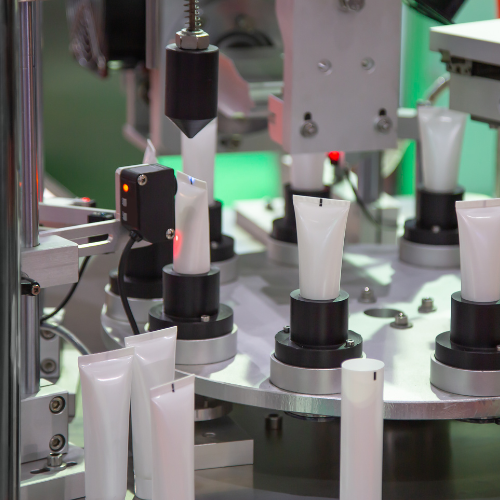
In many low-MOQ projects, packaging becomes the biggest limitation. Bottles, jars, tubes, and pumps are typically produced through injection molding or glass manufacturing processes that require much larger production runs. For standard packaging components, MOQs commonly begin around 5,000–10,000 units, depending on the packaging type and supplier. This means a brand may be able to manufacture a smaller batch of formulation while still being constrained by packaging availability.
How Small Brands Source Packaging Below Standard MOQ
If a brand needs fewer containers than the original packaging manufacturer’s MOQ, one common solution is working with stock packaging suppliers. These suppliers purchase packaging components in bulk and resell them in smaller quantities specifically for brands with lower production volumes. This isn’t leftover inventory from someone else’s project—it’s inventory intentionally stocked to support smaller brands.
The trade-off is straightforward: Lower quantities are possible, but packaging choices become more limited and the cost per unit is usually higher.
Decorating Low-MOQ Containers: Two Common Options Once you’ve selected stock packaging, the next step is branding it. There are two common approaches.
1. Sticker Labels Labels are printed separately and applied to the container. This is the most flexible option for low-MOQ production because it requires relatively low setup costs and allows easier design changes.
2. Direct Container Printing Some specialized printing companies can print directly onto stock containers using methods such as pad printing or silk screen printing. This creates a cleaner, more premium appearance without requiring the original packaging manufacturer’s full MOQ. However, both options share one important limitation.
Low-MOQ packaging generally doesn’t allow highly customized finishing such as custom embossing, stamping, custom caps.
Those features usually require producing packaging directly through the packaging manufacturer at much higher minimum quantities. At lower volumes, successful brands usually focus on clean design, strong typography, thoughtful color selection, and excellent branding rather than expensive packaging customization.
The Cost Math Many Brands Don’t Consider
One common misconception is that a lower MOQ automatically reduces costs. In reality, lower MOQ almost always means a higher cost per unit. Many manufacturing costs remain relatively fixed regardless of production volume, including:
- Production setup
- Equipment preparation
- Manufacturing labor
- Quality control
- Documentation
For example, producing 1,000 units spreads these fixed costs across far fewer products than producing 5,000 units. As a result, the manufacturing cost per unit increases. Once demand has been validated, producing larger quantities often becomes the more cost-efficient decision.
Why Small Brands Still Choose Low MOQ
If larger production runs are more cost-efficient, why do so many startups still choose low MOQ? Because for a new brand, the biggest risk usually isn’t manufacturing cost. It’s inventory risk. Unsold inventory creates:
- Tied-up capital
- Storage costs
- Cash flow pressure
- Obsolete inventory
For brands that haven’t yet validated market demand, paying a higher manufacturing cost per unit can actually be the smarter financial decision. The real decision isn’t about finding the cheapest production option. It’s about balancing manufacturing cost against inventory risk. Low MOQ isn’t about achieving the lowest unit cost.
It’s about managing risk during the early stage of a brand. Neither approach is inherently right or wrong. The best choice depends on your brand’s current stage and growth strategy.
How Can Small Brands Reduce MOQ When Working with Korean ODM Manufacturers?
For brands launching their first product, the most practical strategy is usually to reduce unnecessary customization in the beginning. That often means:
- Choosing stock packaging instead of custom molds
- Selecting ingredients already available through the manufacturer whenever possible
- Validating market demand before investing in custom packaging or larger production quantities
Once demand is proven, brands can gradually transition to customized packaging, larger production volumes, and improved cost efficiency.
WITH.C KOREA’s Approach to Low MOQ
Low MOQ is not our standard manufacturing model. We’ve occasionally supported selected pilot projects, but our focus has always been long-term partnerships and products built for sustainable growth. Rather than pursuing the lowest possible MOQ, we believe every production should create the right foundation for a brand’s future.